Winter installation of additional measuring devices
On February 5 and 6, 2026, we put two new instruments into operation on our northern measuring terrace: a high-volume aerosol sampler from Digitel and a low-volume aerosol sampler from Leckel.
The unusually snow-poor winter worked in our favor: the terraces were hardly covered with snow, so the installation could be carried out smoothly. In snowy winters, outdoor installation is much more difficult or sometimes even impossible.
Both devices collect aerosol particles from the air on special filters. These filters, loaded with aerosol particles, are then analyzed in detail in the laboratory using various methods.
Investigation of Saharan dust
Some of the measurements are being carried out as part of the German-Spanish DUSTIMPACT project (DustImpact, led by Prof. Konrad Kandler, Technical University of Darmstadt; Prof. Martina Klose, Karlsruhe Institute of Technology (KIT); Prof. Carlos Perez and Dr. Jerónimo Escribano, Barcelona Supercomputing Center; Dr. Marco Pandolfi, Consejo Superior de Investigaciones Científicas: Barcelona). In particular, coarse dust particles in the size range of a few micrometers are being investigated during Saharan dust events. In addition, an optical particle counter (Fidas system from PALAS) was installed to continuously record the size distribution of particles, especially in the 2-100 µm range. The aim is to gain new insights into the properties of Saharan dust and the changes it undergoes during its transport through the atmosphere; to this end, additional measuring stations are also being set up along the transport route.
Focus on biological particles with the high-volume sampler
The high-volume sampler (project: AeroCloud-AT) is designed to draw in particularly high volumes of air (600 L/min) so that as many particles as possible are captured on the filter. Thanks to a so-called TSP inlet (Total Suspended Particulates), particles with a diameter of more than 10 µm can also be captured. Of particular interest are biological components of the aerosol, such as pollen, fungal spores, bacteria, or fragments of biological material. These play an important role in the environment, climate, and health and are therefore a central component of our research.
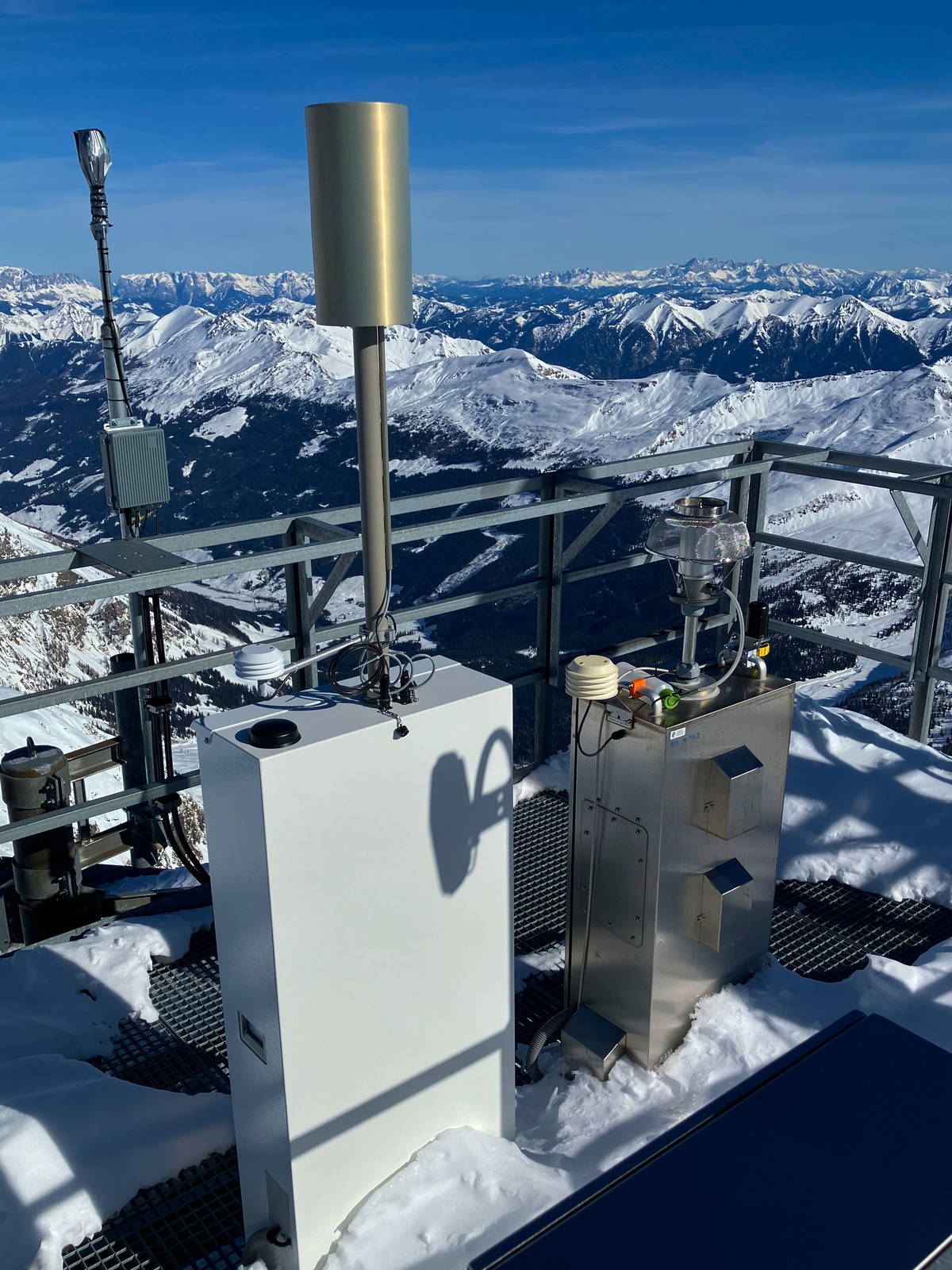
Foto: Julia Burkart - GeoSphere Austria